Indeed it is a good morning for my radioactive level is down to 18.3. Praise God. It was a funny night last night because code red was called for my room. Meaning: FIRE!!! Ha ha it was just me using the hot shower. Apparently, the fire detector in the room has been acting like that so it is not the first time that this happened. It's funny i was in the shower enjoying my night shower when suddenly my phon kept ringing endlessly. How am i supposed to answer that? Ha ha ha I took my towel and covered my body, went out and there i saw the nurses looking at me through the looking glass. They were telling me we had a code red. The steam! Anyway today could be my freedom ha ha ha
Thursday, November 19, 2015
Tuesday, November 17, 2015
Ablation Day: Step 5 RAI
I am now in the ablation room ohee American Hospital Dubai. After my second dose of Thyrogen earlier, this is it. Three hours after the last dose of Thyrogen, bloods were extracted.
About 3:15 p.m. i took the RAI tablet. It is a white tablet sealed in a gray bucket all lead covered (see picture) There is a tube like straw that the technician puts in the bucket to pick up the tablet. But when picking up the tablet, i had to do it myself as the technician had to stay far away from me.
So i picked up the tube and put the other end of the tube in my mouth with tablet sliding through the tube to my mouth and with water i pushed it down my stomach. The dose was 105.2 mCi.
Dr. Yang, the technician and the nurse were all outside my room.
I was instructed to lie down for 10 minutes to measure my radiation level.
The level was 163 uSV wohoooo....
Monday, November 16, 2015
Second Thyrogen injection: Step 4 to RAI
Had my Thyrogen injection at 9:30 a.m. today. This is my last of two injections. So far, so good. Continuously praising God for all of this as i await for another victory.
Thursday, September 17, 2015
What is papillary thyroid carcinoma?
When the "bomb" was thrown to me three days ago, i read and re-read the test results, the laboratory tests, medical reports and operative report. It says carcinoma...papillary thyroid carcinoma. What in the world is papillary thyroid carcinoma?
- Papillary and follicular thyroid cancers are referred to as differentiated thyroid cancer, which means that the cancer cells look and act in some respects like normal thyroid cells.
- Papillary and follicular thyroid cancers account for more than 90% of all thyroid cancers. They tend to grow very slowly.
- Their variants include columnar, diffuse sclerosing, follicular variant of papillary, Hürthle cell, and tall cell. Two other variants (insular andsolid/trabecular) are considered to be intermediate between differentiated thyroid cancer and poorly differentiated thyroid cancer. The variants tend to grow and spread more than typical papillary cancer.
- If detected early, most papillary and follicular thyroid cancers can be treated successfully. Their treatment and management are similar and are based on staging and individual risk levels.
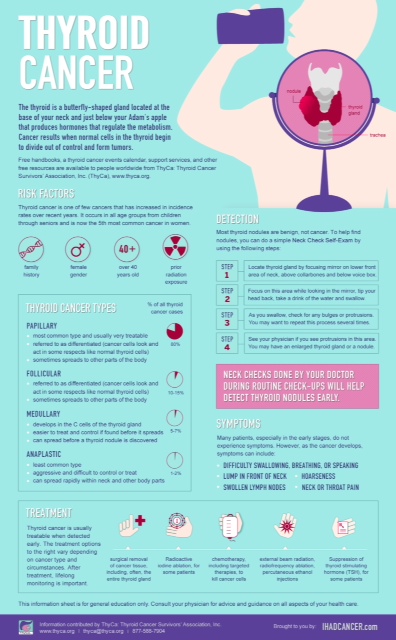
- Papillary thyroid cancer is the most common type of thyroid cancer. It accounts for about 80% of all thyroid cancers. Papillary thyroid cancer generally grows very slowly, but can often spread to lymph nodes in the neck. It also can spread elsewhere in the body.
- The most common variant of papillary is the follicular variant (not to be confused with follicular thyroid cancer). It also usually grows very slowly. Other variants of papillary thyroid cancer (columnar, diffuse sclerosing, and tall cell) are not as common and tend to grow and spread more quickly.
- Follicular thyroid cancer accounts for about 10-15% of all thyroid cancers. Treatment will be discussed later in this booklet. Hürthle cell thyroid cancer is a variant of follicular.
- Follicular thyroid cancers usually do not spread to the lymph nodes, but in some cases can spread to other parts of the body, such as the lungs or bones.
- Treatment for follicular thyroid cancer is similar to treatment for papillary. Hürthle cell cancer (also known as oncocytic or oxyphilic) is less likely than other differentiated thyroid cancer to absorb radioactive iodine, which is often used for the treatment of differentiated thyroid cancer.
- A protein called thyroglobulin (abbreviated Tg) is used as a marker for whether all of the differentiated thyroid cancer has been successfully removed. Determining the Tg level in your blood by periodic testing will help your doctors determine how well you are doing with your treatment. Some patients produce anti-thyroglobulin antibodies (TgAb), which are not harmful but which mask the reliability of the Tg value.
Sunday, September 13, 2015
How to survive hemithyroidectomy - Week One
Saturday, September 12, 2015
September is Thyroid Cancer Awareness month - Get checked
Thyroid cancer cases have been increasing globally. It is a disease wherein abnormal cells grow in the thyroid. The thyroid is found in the neck. It is butterfly shaped located just above the larynx and the trachea.
What are the symptoms of thyroid nodule?
I never felt any of these but accidentally in one of the workshops in the hospital where i am working for, they found a nodule in my right thyroid.
1. Lump in the neck sometimes not readily felt and can grow quickly.
2. Swelling in the neck.
3. Pain in the neck.
4. Difficulty swallowing.
5. Difficulty breathing.
6. Frequent cough
These symptoms may or may not be cancer. It is still good to be safe and get checked. I never felt any or was not aware that it could be a thyroid nodule when they found out i had one. It better to get checked earlier and have peace of mind.
For more info, Thyca.org or if you are in Dubai, you may contact the American Hospital Dubai.
Wednesday, September 9, 2015
I've got thyroid nodule
The pictures above showed how they did the test. On the last picture, the monitor showed that they found a right thyroid nodule. Immediately, i went straight to another endocrinologist even though the neck surgeon told me that I can have it checked or just let it be as most of us have nodules in the neck. I decided to get checked by an endocrinologist.
The endocrinologist did some palpation. The nodule was too small to be palpated. He ordered some blood tests. The blood tests were normal - TSH, FT4 and FT3, all these tests for the thyroid were all normal.
The next visit, he did an FNA.
FNA - Fine Needle Aspiration biopsy.
According to Wikipedia. Fine-needle aspiration biopsy (FNAB, FNA or NAB), or fine-needle aspiration cytology (FNAC), is a diagnostic procedure used to investigate superficial (just under the skin) lumps or masses. In this technique, a thin, hollow needle is inserted into the mass forsampling of cells that, after being stained, will be examined under a microscope. There could be cytology exam of aspirate (cell specimen evaluation, FNAC) or histological (biopsy - tissue specimen evaluation, FNAB).[1] Fine-needle aspiration biopsies are very safe, minor surgical procedures. Often, a major surgical (excisional or open) biopsy can be avoided by performing a needle aspiration biopsy instead. In 1981, the first fine-needle aspiration biopsy in the United States was done at Maimonides Medical Center, eliminating the need for surgery and hospitalization. Today, this procedure is widely used in the diagnosis of cancer and inflammatory conditions.[2]
The endocrinologist did an FNA. Just like a dart thrown on my neck and tried to get tissue samples from the nodule. He did succeed but the cytology revealed not enough tissue to make a diagnosis.
The doctor ordered ultrasound of the neck that revealed the nodule measuring 1.2 x 1.2 x 1.2 cm, round, hypoechoic without internal vascularity.
The endocrinologist told me that these types are suspicious for malignancy, so he wanted to get another FNA but this time ultrasound guided.
So, the doctor ordered again an ultrasound-guided FNA, again!
The ultrasound-guided biopsy was done in the Imaging Department by a radiologist with the ultrasonographers (there were 2) and cytologist to get the specimen. It took three times of pricking and probing to get a sufficient specimen.
The results came and it was really suspicious for malignancy. Thus, the nodule needed to be excised.
I was referred to the ENT surgeon.